
Why Landscape Drainage Systems Prevent Costly Foundation Problems in Summerfield
Summerfield sits on some of Central Florida’s most challenging terrain. Sandy soil, frequent heavy rainfall, and low-lying property elevations create conditions where water constantly accumulates around homes and infiltrates foundations. Every rainstorm brings new moisture concerns. Every heavy downpour introduces the risk of foundation settling, cracking, and water intrusion that can cost thousands of dollars to repair.
The homeowners in Summerfield who avoid these expensive disasters are the ones who invest in professional landscape drainage systems before problems develop. These engineered solutions intercept water before it reaches your foundation, directing it safely away from the structure and eliminating the conditions that cause foundation damage.
Why Summerfield Drainage Problems Are Particularly Aggressive
Summerfield’s geography and soil composition create drainage challenges that are more intense than those of many Florida communities.
Sandy Soil Provides Minimal Water Absorption
Summerfield’s sandy soil looks like it should absorb water readily, but in reality, the opposite is true. Water moves through sand very quickly, but sand does not retain water or allow it to filter deep underground. Instead, water runs horizontally along sand layers, channeling toward the lowest points. If those low points happen to be adjacent to your home’s foundation, water concentrates and pools there continuously.
Flat Terrain Creates Water Collection Points
Much of Summerfield sits on nearly flat terrain. Unlike sloped properties, where water naturally runs away from structures, flat properties create natural collection basins where water settles and persists. After rainstorms, standing water remains on flat yards for days, gradually soaking into the soil and toward foundations below.
High Water Table Saturation
Summerfield’s proximity to groundwater means the water table is relatively high. During the rainy season, the water table can rise dramatically, essentially filling the soil layer beneath your home like a sponge. This saturation pressure pushes moisture up into foundations and crawl spaces through capillary action and hydrostatic pressure.
Heavy Rainfall Volume in Summer Months
Central Florida’s summer thunderstorms dump enormous volumes of rain in brief periods. A single afternoon storm can deposit 3 to 4 inches of rain in under an hour. Summerfield’s sandy soil and flat terrain cannot absorb this volume quickly enough, forcing water to concentrate in surface pools and flow toward foundations.
What Happens When Drainage Systems Fail
When landscape drainage is inadequate or nonexistent, a cascade of expensive problems follows predictably.
Foundation Settling and Cracking
Persistent moisture around foundations causes the soil beneath them to shift and settle. As saturated soil dries, it shrinks, creating voids beneath the foundation. When it rains again and becomes saturated, the foundation sinks into those voids. This settling stress causes cracks in concrete slabs and foundation walls, beginning as hairline fractures and widening over the years into structural concerns.
Water Intrusion Into Crawl Spaces and Basements
Hydrostatic pressure from water-saturated soil around the foundation forces moisture through tiny cracks and pores in concrete. Basements and crawl spaces flood. Moisture accumulates on the floor and walls. Mold and mildew grow. The property becomes uninhabitable until the moisture problem is solved at its source.
Siding and Structural Rot
Water that pools against the foundation exterior eventually makes contact with wood siding, window frames, and wooden components that support the structure. Years of moisture exposure cause wood rot that weakens structural elements and accelerates the deterioration of materials designed to last decades.
Landscape Damage and Aesthetic Decline
Persistent standing water kills grass and plants. Erosion washes away topsoil and mulch. Pavers and hardscape elements shift and settle unevenly. The once attractive landscaping becomes a mud pit with dead vegetation and unstable surfaces.
How Professional Landscape Drainage Systems Work
Professional drainage systems employ multiple strategies to intercept water before it causes damage.
French Drain Installation
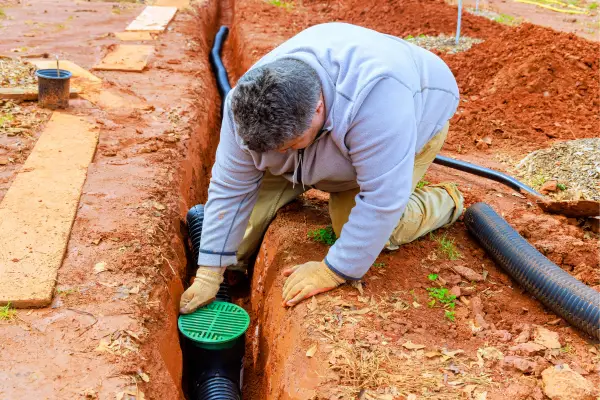
French drains are perforated pipes buried in the soil adjacent to the foundation. Water that would otherwise pool around the foundation enters the perforations and travels through the pipe to a drainage outlet away from the structure. This simple but highly effective system can be installed around the perimeter of the home and under landscaping features like patios and gardens.
Surface Grading Adjustment
Professional grading directs water away from the foundation by sloping the ground surface away from the structure. Water that would previously flow toward the foundation now flows toward drainage swales, rain gardens, or designated drainage points where it is safely dispersed or absorbed gradually rather than overwhelming the soil adjacent to the foundation.
Swale Installation and Maintenance
Drainage swales are shallow, vegetated channels that capture surface water and direct it away from structures. Plants in the swale absorb excess moisture, and the gentle slope ensures water moves continuously away from vulnerable areas. Swales work beautifully in Summerfield’s flat terrain by creating a subtle slope where none naturally exists.
Rain Garden Construction
Rain gardens are shallow depressions planted with water-loving vegetation that capture surface runoff and allow it to filter slowly into the soil away from structures. These features manage water volume during heavy rains while improving the landscape aesthetically and supporting native plants and wildlife.
Downspout Extension and Relocation
Gutter downspouts that empty within a few feet of the foundation concentrate water directly where it causes the most damage. Extending downspouts or relocating them to drain into drainage systems ensures water is transported far from the structure before it has a chance to infiltrate foundations or pool in landscaping beds.


