
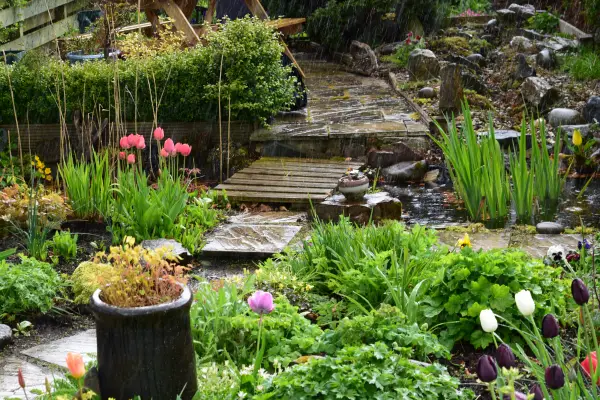
How Rain Gardens Solve Drainage Problems While Beautifying Florida Yards
Standing water after every storm is one of the most common complaints among Central Florida homeowners. Low spots in the yard collect runoff, stay saturated for days, and kill grass in expanding circles. Traditional drainage solutions like French drains and regrading work well, but they are purely functional. They solve the water problem without adding anything to the landscape.
A rain garden offers a different approach. It solves the drainage problem and creates a beautiful, intentional feature that supports wildlife, reduces maintenance, and adds visual interest to an otherwise frustrating area.
What a Rain Garden Actually Is
A rain garden is a shallow, planted depression designed to collect and absorb stormwater runoff from roofs, driveways, and lawns. It is not a pond. It is not a wetland. It is a garden bed that is specifically positioned and planted to handle periodic flooding, absorb that water within 24 to 48 hours, and remain dry between rain events.
The plants in a rain garden are selected for their ability to tolerate both wet and dry conditions. The soil beneath is amended or engineered to drain efficiently while filtering pollutants from the runoff.
How Rain Gardens Solve Drainage Problems
Traditional drainage moves water from one place to another. Rain gardens absorb water where it collects, eliminating the problem at its source.
Capturing Runoff Before It Pools
By positioning the garden where water naturally flows, it intercepts runoff before it reaches problem areas. The water fills the garden’s shallow basin and is absorbed through the amended soil and root systems below.
Reducing Volume Downstream
Every gallon that soaks into a rain garden is a gallon that does not flow across your yard, erode your landscape, or pool near your foundation. This reduces the overall drainage load on your property.
Filtering Before Absorption
As water passes through the rain garden’s soil layers and root systems, pollutants like fertilizer runoff, sediment, and chemicals are filtered naturally. The water that enters the groundwater below is cleaner than what entered the garden.
Why Rain Gardens Work So Well in Central Florida
Florida’s climate and soil conditions actually favor rain gardens.
Abundant Native Plant Options
Central Florida has dozens of native plants that thrive in the wet-dry cycle a rain garden experiences. Species like blue flag iris, muhly grass, coreopsis, and swamp sunflower are perfectly adapted to periodic flooding followed by dry periods.
Sandy Soil Drainage
Florida’s sandy subsoil drains efficiently once water passes through the amended garden soil above. This means rain gardens in Central Florida rarely stay wet for more than a day or two, reducing mosquito concerns and keeping the garden attractive.
Year Round Growing Season
Plants in a Central Florida rain garden grow most of the year actively, which means root systems develop quickly and the garden reaches full function and beauty faster than in cooler climates.
Where Rain Gardens Work Best
Not every drainage problem is suited to a rain garden, but many common situations are ideal.
Low Spots That Always Flood
The natural low point in your yard where water already collects is often the perfect location for a rain garden. Instead of fighting the topography, a rain garden works with it.
Downspout Discharge Points
Roof runoff from gutter downspouts can be directed into a rain garden instead of allowing it to flow across the lawn and erode landscaping.
Between the Lawn and Property Lines
Rain gardens placed along property edges can intercept sheet flow from your lawn before it leaves your property, reducing the water load on neighboring yards and drainage infrastructure.
Design Considerations for Florida Rain Gardens
A rain garden is not just a hole with plants. It requires specific design elements to function correctly.
Proper Depth and Size
The garden must be sized relative to the drainage area it serves. Too small, and it overflows during heavy storms. Too deep, and it stays wet too long. The ideal depth is typically six to twelve inches.
Soil Amendment
The soil beneath the garden may need amendment to balance absorption speed with water-holding capacity. Pure sand drains too fast for plants. Pure clay holds water too long. The right blend supports both drainage and plant health.
Plant Selection and Layering
Plants should be arranged with the most water-tolerant species in the center (lowest point) and more drought-tolerant species at the edges. This ensures every plant receives the moisture level it prefers.
The Dual Benefit
Rain gardens are unique because they solve a functional problem while creating aesthetic value. Most drainage solutions are invisible or purely utilitarian. A rain garden is a feature, a focal point that attracts butterflies, provides seasonal color, and gives the yard a naturalized beauty that structured beds cannot replicate.
If your yard has persistent drainage problems and you want a solution that adds beauty rather than hiding underground, a rain garden may be the answer that transforms a problem area into the most attractive spot on your property.


