
Why Concrete Landscape Curbing Outperforms Plastic Edging in Florida
Every landscape bed needs a border. That border defines the edge between grass and mulch, between lawn and garden, between maintained and wild. Without a clear, durable edge, grass invades beds, mulch spills into the lawn, and the entire landscape loses its definition within a single growing season.
Homeowners in Central Florida face a choice between several edging options, and two of the most common are plastic landscape edging and poured concrete curbing. While both serve the same basic purpose, their performance in Florida’s demanding climate is dramatically different.
What Plastic Edging Actually Is
Plastic landscape edging is a thin, flexible strip of polyethylene or polypropylene that is buried along the border of a landscape bed. It is held in place by stakes driven into the ground. Its purpose is to create a barrier between grass and mulch that keeps each in its designated area.
Plastic edging is inexpensive and widely available. It is also one of the most commonly failed landscape products in Florida.
Why Plastic Edging Fails in Florida
Florida’s climate attacks plastic edging from every direction.
UV Degradation
Plastic exposed to Florida’s intense UV radiation becomes brittle over time. The material that was flexible during installation turns rigid and cracks. Once cracked, it no longer holds shape or contains the bed material.
Heat Warping
On hot days, plastic edging softens and warps. It loses its straight lines and begins to buckle, creating an uneven border that looks messy and fails to contain mulch or rock.
Shallow Root Pressure
Florida’s aggressive grass varieties, particularly St. Augustine and Bahia, send runners that easily push under, over, and through plastic edging. Within one growing season, grass invades the bed despite the edging being present.
Stake Failure in Sandy Soil
The stakes that hold plastic edging in place rely on soil grip. Florida’s sandy soil provides poor holding power. Stakes loosen, edging lifts, and the border loses contact with the ground.
What Concrete Landscape Curbing Is
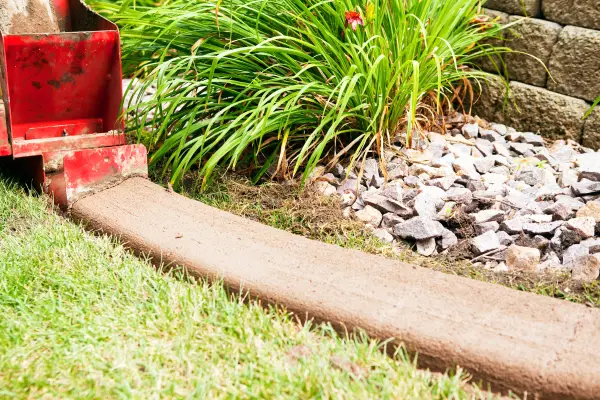
Concrete curbing is a continuous ribbon of concrete extruded directly onto the ground along the border of your landscape beds. It cures in place and becomes a permanent, solid border that grass cannot cross and mulch cannot escape.
Curbing can be finished in various textures, colors, and profiles to match the home’s style. Once installed, it requires no stakes, no adjustment, and no annual replacement.
Why Concrete Curbing Performs Better in Florida
The properties that make concrete curbing more expensive also make it dramatically more durable.
Permanence
Concrete does not degrade in UV light. It does not warp in heat. It does not become brittle over time. A properly installed curb maintains its shape and position for decades.
Root Resistance
Concrete curbing sits on the soil surface with enough mass and depth to resist the pressure of grass runners. St. Augustine cannot push through or under it the way it pushes through plastic.
Clean Definition Year After Year
Because curbing does not shift, warp, or buckle, the borders of your landscape beds remain crisp and defined through every season. The contrast between lawn and bed stays sharp without annual correction.
Reduced Maintenance
Beds bordered by concrete curbing require less frequent edging, less mulch replacement (because it stays contained), and less time spent pulling grass runners from the beds. The curb does the work that homeowners otherwise do repeatedly.
The Aesthetic Impact
Beyond function, landscape curbing provides a visual upgrade that plastic edging cannot match. The clean, continuous lines of concrete curbing frame the landscape like a border frames a painting. It communicates care, intention, and permanence that loose plastic strips never achieve.
For homeowners preparing to sell, curbing is one of the highest-impact, lowest-cost improvements available. It makes the entire yard look finished and maintained without replacing a single plant.
When Plastic Edging Makes Sense
Plastic edging has a place in temporary applications, seasonal beds, or areas where the landscape layout may change soon. It is not a permanent solution and should not be treated as one, especially in Florida where the climate accelerates every failure mode.
Invest in a Border That Lasts
Your landscape beds deserve a border that works as hard as the plants and materials inside them. Concrete curbing provides that permanence in Florida’s climate, eliminating the annual replacement cycle and keeping your yard looking defined and intentional through every season.


